
Editorial and Formatting Guidelines
Asterisks (*) in Taishō Tripiṭaka Apparatus Entries
In the Taishō Tripitaka, an asterisk (*) attached to a critical apparatus entry indicates that subsequent instances in the main text sharing the exact same textual variant are abbreviated and represented by an asterisk alone.
The function of asterisked apparatus entries in the Taishō Tripitaka is explained in the “Textual Variant Sigla” (校異略符) section at the end of the edition as follows:
|
Ditto (So below, So above, et passim) Example: Text: 世尊正[1]遊知 Note: [1]遊=遍【三】* where 遊 read as 遍 in all three editions, same as below. |
Below is an explanation of the Display and Copy & Cite functions in the CBETA reading software (CBReader):
1. Display in CBReader
Example:
《長阿含經》:「謂四[9]扼。欲[*]扼.有[*]扼.見[*]扼.無明[*]扼。復有四法。謂四無[*]扼。無欲[*]扼.無有[*]扼.無見[*]扼.無無明[*]扼」(CBETA, T01, no.1, p. 51, a22-24)
The apparatus entry [9] above reads:
[9]扼=枙【宋】【元】【明】【聖】*
The critical apparatus fields at the bottom of CBReader display as follows:
[0051009] 扼=枙【宋】【元】【明】【聖】* [* 1 2 3 4 5 6 7 8 9]
p. 51, [9-1] 扼=枙【宋】【元】【明】【聖】*
The [9-1] above indicates that this is the 1st * content out of a total of 9 textual variants. Details are shown in the figure below:
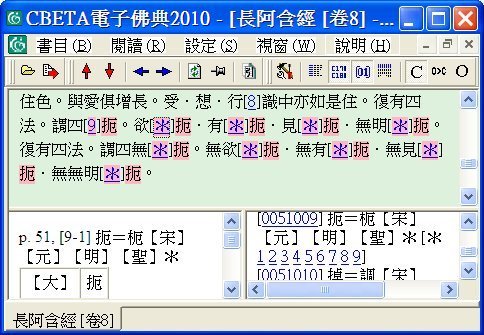
For variant readings marked with an asterisk [*], the annotation window displays links to all corresponding [*] occurrences, enabling users to navigate quickly between instances and jump directly to the primary apparatus entry.
2. “Copy & Cite” Function in CBReader
Selecting the passage above, clicking “Copy & Cite”  , and opting to include apparatus entries (along with asterisks) yields the following output:
《長阿含經》「謂四[9]扼。欲[*]扼.有[*]扼.見[*]扼.無明[*]扼。復有四法。謂四無[*]扼。無欲[*]扼.無有[*]扼.無見[*]扼.無無明[*]扼」(CBETA,
T01, no. 1, p. 51, a22-24)
[9]扼=枙【宋】【元】【明】【聖】*
[*9-1]扼=枙【宋】【元】【明】【聖】*
[*9-2]扼=枙【宋】【元】【明】【聖】*
[*9-3]扼=枙【宋】【元】【明】【聖】*
[*9-4]扼=枙【宋】【元】【明】【聖】*
[*9-5]扼=枙【宋】【元】【明】【聖】*
[*9-6]扼=枙【宋】【元】【明】【聖】*
[*9-7]扼=枙【宋】【元】【明】【聖】*
[*9-8]扼=枙【宋】【元】【明】【聖】*
[*9-9]扼=枙【宋】【元】【明】【聖】*