
📨 We’ve compiled the following information in respond to the general inquiries on our e-books. Hope you may find it handy!
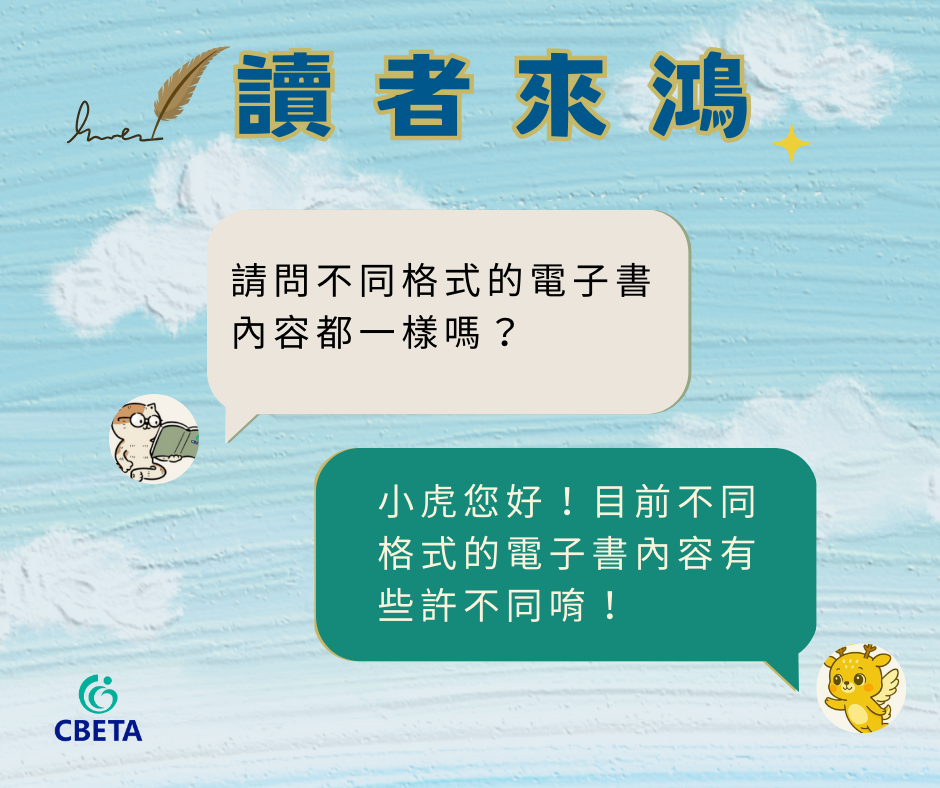
Q: Is the content the same across different formats?
📚 The content of e-books in different formats varies slightly. Please refer to the chart below (in Chinese) to understand the features and content differences of each format.
⚠️ Note: The information in the table is based on the 2025.R3 version; future updates may result in further changes.
CBETA E-Books: Format Comparison
| Format | Contains Taisho Tripitaka (T1–T55, T85)? | Contains Manji Zokuzokyo (Xuzangjing)? | Contains Other Texts? | Contains CBETA Revision Notes? |
|---|---|---|---|---|
| DOCX | ✔️ | ❌ (Pending) | ❌ (Pending) | ✔️ |
| TXT | ✔️ | ✔️ | ✔️ | ✔️ (Optional) |
| EPUB | ✔️ | ✔️ | ✔️ | ❌ |
| ✔️ | ✔️ | ✔️ | ❌ | |
| MOBI | ✔️ | ✔️ | ✔️ | ❌ |
CBETA E-Books: Format Features & Usage
| Format | Feature & Usage |
|---|---|
| DOCX | Open for editing and annotation. Best suited for academic research and citation. |
| TXT | Complete plain-text dataset. Ideal for software development/programming, full-text searches, and corpus analysis. |
| EPUB | Complete set of texts. Optimized for reading on computers, tablets, and smart phone-friendly, though some may experience table of contents (TOC) compatibility issues. |
| Fixed layout. Best suited for reference lookup and printing. | |
| MOBI | Specifically formatted for Kindle users. |
Q: Is the complete Taisho Tripitaka offers in DOCX format?
📜 Currently, our DOCX e-books include Volumes 1 to 55 and Volume 85 of the Taisho Tripitaka, as authorized by the Daizo Shuppan.
However, the DOCX format conversion process is ongoing, therefore more texts beyond the Taisho Tripitaka will be provided in the future. Additionally, we are also improving the rendition of Siddham characters, aiming to provide clearer and reader-friendly e-books.
Q: What should I do if I have problems opening DOCX files with different versions of MS Word?
📔 A reader shared that the ODT format is a solution for this scenario. We are troubleshooting with some assessments and look forward to providing a better user experience in future updates.
We welcome everyone to make good use of CBETA e-books and unleash the power of a tiger with horns! (Roar~~) 🔱🐯